

Did you know that 42% of startups fail because there’s no real market need for their product? That’s a huge number, and it often occurs when teams skip proper MVP testing before scaling.
Pause for a moment and think about this: Are you really developing a solution that addresses users’ actual needs, or are you simply creating what you believe is a smart concept?
This is where testing your Minimum Viable Product (MVP) can help. It allows you to learn about your users, validate your idea, and avoid costly mistakes. It’s better to test, learn, and improve before rushing to expand.
In this blog, you will learn simple and effective ways to test your MVP, gather insights, and confidently scale your product.
Table of Contents
Why Testing Your MVP Before Scaling is Important
Testing your Minimum Viable Product (MVP) helps you validate demand, understand user behavior, and identify what truly works before you scale. You can improve your product, fix problems, and deliver real value based on feedback from early users, not just assumptions.
This approach reduces risks, prevents unnecessary costs, and helps teams work smarter with better decisions and confidence.
What to Validate in a Minimum Viable Product (MVP)
When creating your MVP, ensure that it solves a real problem for your users. It’s not just about if the product works, it’s about the value it gives. Pay attention to how easily users understand it, how useful it is, and whether they return or are willing to pay for it.
It’s equally important to see if your messaging connects and stands out in the marketplace. If you skip this validation, scaling out is a risky move, not a confident and strategic move.
6 Steps to Test Your Minimum Viable Product (MVP) Before Scaling
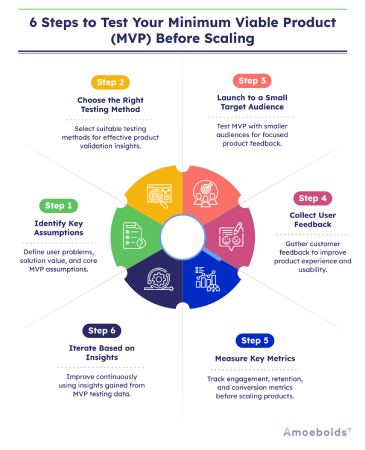
A structured testing approach gives you the opportunity to validate your MVP, gain real user insights and mitigate risk before scaling.
Step 1: Identify Key Assumptions
Describe the key assumptions of your MVP, about your users, the problem they have, and your solution. Checking these early on with Minimum Viable Product testing allows you to focus on what’s important while reducing the risk of creating something users don’t want.
Step 2: Choose the Right Testing Method
Choose a testing method that fits your product and goals. The right method, be it user interviews, A/B testing, or landing pages, will help you collect meaningful insights. It will also help you to allow effective product validation without wasting your time and effort.
Step 3: Launch to a Small Target Audience
Start with a small group of target users, not a full launch. This makes MVP testing easier, helping you get targeted feedback and improve your product
Step 4: Collect User Feedback
Actively get customer feedback to understand how they are experiencing your MVP. Use simple methods such as surveys or in-app prompts to collect real-world data so you can enhance the user interface, close gaps, and strengthen your product validation process.
Step 5: Measure Key Metrics
Monitor key metrics such as user engagement, retention rate, and conversion rate to figure out how well your minimum viable product is performing. These numbers provide clear signals about what works, allowing you to make better decisions before scaling your product.
Step 6: Iterate Based on Insights
Use learnings from MVP testing to improve continuously. Small changes based on real data can significantly enhance the user experience, allowing you to create a stronger product and grow with greater confidence and simplicity.
Common Mistakes to Avoid When Testing an MVP
Avoiding common MVP testing mistakes saves time, resources, and effort while also allowing you to validate your product more accurately and remain focused.
- Testing too many features at once: This can reduce feedback and make it difficult to identify what is actually working. It’s hard to tell which feature is driving results or causing issues.
- Ignoring negative feedback: Key insights frequently come from dissatisfied users, and ignoring them can lead to bigger problems later. Addressing this feedback enhances your product and fosters trust.
- Relying on vanity metrics: Metrics like downloads or page views may appear impressive, but they do not reflect true engagement. They can cause wrong decisions and make it hard to see if your MVP is actually adding value or not.
- Scaling too early: Expanding without proper validation may exacerbate existing flaws and inefficiencies. This often leads to wasted resources, increased costs, and problems that are more challenging to fix later.
Signs Your MVP is Ready to Scale
Knowing when to scale shows that your MVP has a solid foundation and product-market fit. Look at trends, not specific indications of success.
- Consistent user engagement: Users keep coming back and actively using your MVP, showing real interest. This steady interaction is a strong signal during MVP testing that your product delivers value.
- Positive feedback trends: User feedback improves over time gradually and shows greater satisfaction. It means your product validation is working and your MVP is solving users’ needs.
- Strong retention and low churn: Users continue using your product instead of dropping off. High retention and low churn show your MVP solves a real problem and supports long-term product growth.
- Repeat usage or referrals: Users return frequently and start recommending your product to others. This organic growth signals strong MVP validation and builds confidence before moving into scaling.
Conclusion
Conducting tests on your MVP before you scale is not just a step, it’s a smart and required strategy. It allows you to make decisions based on real user insights, to mitigate risk, and to build a product that really delivers value.
You’re laying a solid foundation for future growth by focusing on MVP testing, collecting user feedback, tracking key metrics, and making improvements.
This way scaling feels more confident and controlled, not risky or rushed.
So, are you ready to grow your product with clarity and confidence?
Start testing your MVP today before investing in scaling, your future growth depends on it.

