

Eventually old iron heating risers will begin to corrode, leak, develop flow problems or otherwise wear out. If you are researching colonne montanti riscaldamento in ferro come sostituire 20 metri, the reality is that changing 20m of pipe is not merely a cut and replace operation.
In a centralized heating system, the riser likely serves many apartments, and its hydraulic properties affect the remaining part of the circuit.
Systems with vertical risers carry heat throughout the supply/return loop, with branch connections to different levels for the individual heating appliances.
As such, the best course of action is a considered engineering and plumbing installation project rather than merely a quick, easy fix.
Table of Contents
What Is a Heating Riser?
A heating riser, or colonna montante, is a vertical pipe or group of pipes that distributes heating water between different levels of a building.
In older residential buildings, these pipes were often made from steel or iron-based materials. A typical centralised system may contain:
- a heat generator or district-heating substation;
- main distribution pipes;
- vertical supply risers;
- vertical return risers;
- radiator branches;
- valves and balancing components;
- pumps and control equipment.
In a traditional vertical system, several radiators positioned above one another can be connected to the same vertical distribution route. This is one reason why changing a riser can affect more than one property.
A municipal technical guide describes these systems as vertical distribution networks in which supply and return pipes feed radiators positioned on the same vertical line on different floors.
Why Replace 20 Metres of Old Iron Pipe?
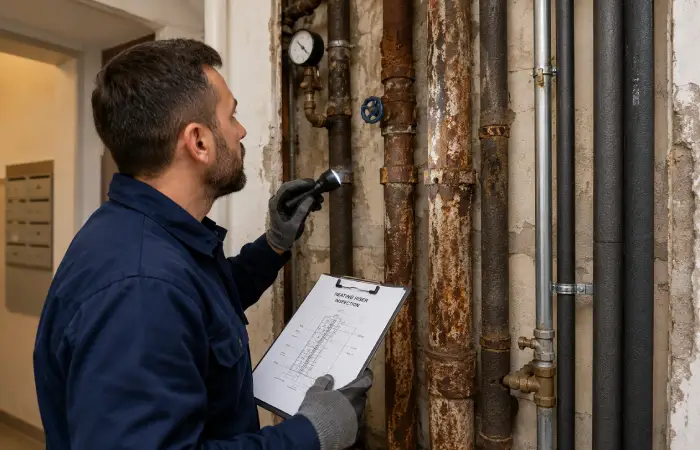
The length itself is not normally the main reason for replacement. The condition and function of the pipe are more important.
Common warning signs include:
Corrosion
External corrosion can weaken the pipe wall, particularly where condensation, moisture or damaged protective coatings are present.
Repeated leaks
A pipe that has already required several repairs may indicate more widespread deterioration.
Reduced internal diameter
Corrosion products and deposits can reduce the effective internal passage, potentially affecting water circulation.
Visible rust or scaling
Heavy corrosion around joints, supports or threaded connections deserves professional inspection.
Poor insulation
Old risers may have inadequate thermal insulation, increasing heat loss to areas where heat is not required.
Renovation work
A building refurbishment can provide an opportunity to replace deteriorated pipework before a serious failure occurs.
However, a rusty appearance does not automatically mean that an entire 20-metre riser must be replaced. A qualified heating professional should establish whether the problem is local or systemic.
How to Replace 20 Metres of Iron Heating Riser
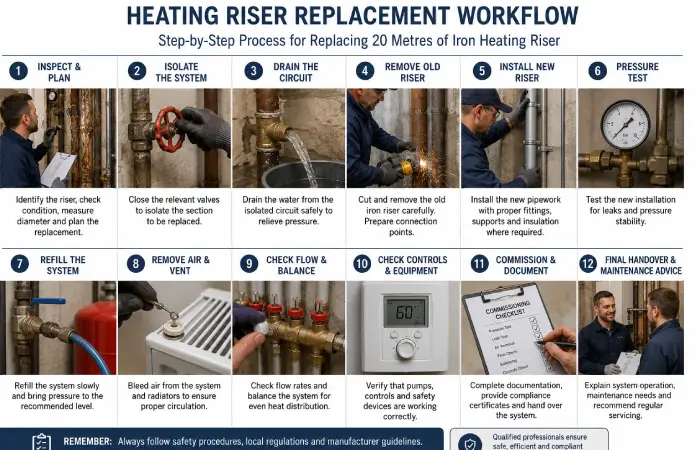
The exact procedure depends on the building, pipe diameter, system design, access and whether the riser is shared.
A typical professional workflow looks like this.
Step 1: Identify the Riser and Its Function
Before removing anything, determine:
- whether the pipe is supply or return;
- which apartments or radiators it serves;
- its diameter;
- its route;
- connection points;
- isolation valves;
- access points;
- whether it is concealed in walls or floors;
- whether it belongs to a communal heating installation.
This information should be documented before work starts.
Step 2: Check the Existing Pipe
The installer should inspect the pipe for:
- wall-thickness deterioration;
- corrosion;
- leaking joints;
- deformation;
- previous repairs;
- damaged supports;
- insulation condition.
For an older system, it can be useful to inspect representative sections rather than assuming every metre has identical deterioration.
Step 3: Determine the Correct Replacement Diameter
This is one of the most important stages.
The new pipe should not simply be selected because it has the same outside diameter as another modern pipe.
The designer or heating engineer should consider:
- required flow rate;
- heating load;
- pipe length;
- pressure drop;
- temperature difference between supply and return;
- pump characteristics;
- existing balancing;
- connection sizes;
- velocity of the water.
Changing from old steel/iron pipe to a modern multilayer or other material may alter internal diameter and hydraulic resistance.
For example, a regional Italian public-works price list gives different installed prices for multilayer heating pipes depending on diameter, from approximately €9.24/m for 16 mm to €65.29/m for 63 mm in its 2025 schedule. These figures are useful for illustrating how strongly diameter affects cost, but they are not a quotation for a residential riser replacement.
Replacement Pipe Options
There is no universally correct material for every building.
Possible solutions include:
| Replacement option | Main advantages | Main limitations | Typical consideration |
| Steel | Strong and familiar for traditional heating systems | Heavier and more labour-intensive | Useful where existing design favours steel |
| Copper | Good thermal and installation characteristics | Material cost and compatibility need checking | Often suitable for accessible sections |
| Multilayer pipe | Lightweight and relatively easy to install | Correct system-rated product and fittings required | Practical for many modern installations |
| PEX-based pipe | Flexible and corrosion-resistant | Must be correctly specified for heating | Useful where routing is difficult |
| Stainless steel | Corrosion resistance and durability | Higher material cost | More specialised applications |
The choice should be based on the system design rather than on the cheapest pipe available.
Current Italian manufacturer price lists show that insulated multilayer heating pipe is available in several diameters and configurations, including 20 mm, 26 mm and 32 mm sizes.
Step 4: Obtain Condominial Approval Where Required
This is particularly important for centralised heating.
If the 20-metre section is part of a communal riser, an individual resident should not assume they can replace it independently.
The riser may serve multiple apartments, and modifying it can affect:
- other residents;
- hydraulic balancing;
- heating availability;
- common areas;
- building fabric;
- maintenance responsibilities.
Italian technical discussions on centralised column systems commonly distinguish the communal risers from individual branches leading towards radiators, although the exact ownership and responsibility should always be checked against the building documentation and condominium arrangements.
Before arranging work, involve the condominium administrator and the qualified heating contractor.
Step 5: Shut Down, Isolate and Drain the Circuit
A heating riser cannot normally be removed safely while it is full of hot, pressurised water.
The professional procedure should include:
- switching off the relevant heating equipment;
- allowing the system to reach a safe temperature;
- isolating the appropriate section;
- draining the affected circuit;
- confirming that pressure has been relieved;
- protecting surrounding areas from residual water.
This is one of the stages that makes a 20-metre riser replacement very different from replacing a short accessible domestic pipe.
Step 6: Remove the Old Iron Section
Once isolated and drained, the old pipe can be removed.
Depending on its location, this may require:
- removal of insulation;
- opening inspection panels;
- controlled cutting;
- removal of old supports;
- access through walls or service shafts;
- temporary protection of nearby surfaces.
If the pipe is concealed inside a wall or floor, demolition and reinstatement can become a significant part of the project.
The installer should also consider whether disturbing old pipework could release corrosion products or deposits into the system.
Step 7: Install the New 20-Metre Section
The new pipe should follow the designed route and be adequately supported.
Important considerations include:
- correct pipe diameter;
- compatible fittings;
- expansion and contraction;
- pipe supports;
- separation from incompatible materials where necessary;
- accessibility of valves and joints;
- thermal insulation;
- protection from mechanical damage.
The installation should avoid unnecessary joints, particularly in inaccessible areas.
The exact fitting system depends on the selected pipe and manufacturer’s installation requirements.
Step 8: Pressure and Leak Testing
Before the system is returned to normal operation, the new section needs to be checked.
A professional commissioning process should verify:
- pipe integrity;
- joints;
- valves;
- connections;
- pressure stability;
- visible leaks;
- correct flow.
The exact test procedure and pressure should be determined by the installer and applicable technical requirements rather than copied from a generic internet guide.
Step 9: Refill, Vent and Balance the System
After successful testing, the circuit can be refilled.
The system may then require:
- air removal;
- pressure adjustment;
- circulation checks;
- radiator checks;
- balancing;
- pump/control verification.
This stage is particularly important when a communal riser has been replaced.
Changing a pipe can affect resistance and flow distribution. An incorrectly sized or poorly balanced replacement may produce symptoms such as insufficient heating in some areas or excessive flow in others.
Technical guidance on modifying risers warns that unqualified changes can affect pressure and circulation and potentially cause system malfunction. For more related articles visit our website
A Practical 20-Metre Replacement Workflow
Here is the simplified process a homeowner or condominium administrator can use when discussing the project with a contractor:
Inspection → System identification → Hydraulic sizing → Approval → Isolation → Drainage → Removal → New pipe installation → Testing → Refill → Air removal → Balancing → Documentation
This workflow helps prevent a common mistake: focusing on the pipe itself while overlooking the heating system around it.
How Much Does Replacing 20 Metres Cost?
There is no reliable single price for 20 metres of heating riser.
The final cost depends on several variables:
| Cost factor | Why it matters |
| Pipe diameter | Larger pipe costs more and may require different fittings |
| Replacement material | Steel, copper, multilayer and other systems have different prices |
| Accessibility | Exposed pipes are easier to replace than concealed ones |
| Height | Vertical work may require additional access equipment |
| Number of floors | More connections can increase labour |
| Wall/floor opening | Building work can become a major cost |
| Drainage/refilling | Shared systems require coordinated shutdown |
| Insulation | New insulation may be needed |
| Testing | Commissioning and leak testing add labour |
| Balancing | Shared systems may need hydraulic adjustment |
| Disposal | Old metal pipework must be removed and disposed of |
| Condominium coordination | Multiple apartments may need access |
For perspective, an official regional 2025 price schedule lists supply and installation of multilayer heating pipe at €9.24/m for 16 mm, €12.77/m for 20 mm, €18.62/m for 26 mm and €24.90/m for 32 mm.
Twenty metres at those unit rates would represent roughly €185–€498 for the listed pipe installation item, before assuming that all the additional conditions of a real 20-metre vertical riser are included.
This is why it would be misleading to say that replacing a 20-metre riser simply costs “20 × the price of a pipe”.
A More Realistic Way to Request a Quote
Ask the contractor to separate the estimate into:
- inspection/design;
- isolation and drainage;
- demolition;
- pipe and fittings;
- installation;
- supports;
- insulation;
- testing;
- system refill;
- balancing;
- masonry works;
- waste disposal;
- documentation.
This makes competing quotations much easier to compare.
What Performance Can You Expect After Replacement?
Replacing a deteriorated riser can restore reliable circulation where the old pipe has become restricted or has developed leaks.
However, a new pipe does not automatically make the entire heating system more efficient.
Performance depends on the condition of:
- the boiler or heat exchanger;
- pumps;
- radiators;
- thermostatic valves;
- controls;
- insulation;
- other distribution pipes;
- hydraulic balancing;
- building insulation.
If the old riser was badly corroded or partially blocked, replacing it may produce a noticeable improvement in flow. If the old pipe was structurally sound and the real problem was poor balancing or control, the benefit may be much smaller.
That distinction is important when evaluating a quotation.
Water Quality and System Cleaning
Pipe replacement is also an opportunity to consider the condition of the heating water.
The current UNI 8065:2019 standard covers the chemical and physicochemical characteristics of water used in heating and air-conditioning systems. UNI lists the standard as currently in force.
This matters because old iron pipework can contribute corrosion products to a heating circuit.
Depending on the condition of the installation, the heating professional may recommend:
- system flushing;
- cleaning;
- water-quality checks;
- corrosion protection;
- appropriate water treatment.
The correct treatment depends on the system and should be determined by a qualified professional rather than applied as a generic chemical treatment.
Compliance and Documentation in Italy
For work on a heating installation in Italy, documentation should not be treated as an afterthought.
Under the framework of D.M. 37/2008, installation companies are required, where applicable, to issue a declaration of conformity after completing regulated installation work and carrying out the required checks. The Chamber of Commerce of Verona summarises the obligation to provide the declaration following the required verification of the installation’s functionality.
A regional guide on D.M. 37/2008 likewise explains that the installer certifies that the system has been made in accordance with applicable technical rules, using suitable components and checking safety and functionality.
For heating systems, maintenance and efficiency-control requirements also sit within the wider framework of D.P.R. 74/2013.
The exact documentation required depends on the nature and scope of the work, so the responsible technician should confirm what applies to the specific installation.
Pros and Cons of Replacing 20 Metres
| Advantages | Limitations |
| Removes a deteriorated pipe section | Can be labour-intensive |
| Reduces the risk associated with a known weak section | May require system shutdown |
| Allows modern insulation to be installed | Access can be difficult |
| Can improve flow if the old pipe was restricted | Does not automatically solve all heating problems |
| Provides an opportunity to inspect the system | May require condominium coordination |
| Can modernise old components | Building repairs can increase the total cost |
Common Mistakes to Avoid
Replacing the pipe with the wrong diameter
A physically compatible pipe is not necessarily hydraulically compatible.
Choosing material based only on price
The cheapest pipe is not automatically the best option for an existing communal system.
Ignoring the return pipe
The supply and return arrangement needs to be considered as part of the complete hydraulic circuit.
Leaving old insulation in poor condition
Replacing the pipe while ignoring damaged insulation can leave avoidable heat losses.
Adding too many hidden joints
Every inaccessible connection introduces another potential future failure point.
Ignoring system balancing
A successful pipe installation can still result in poor heating distribution if the system is not checked afterwards.
Treating a communal riser as private property
This can create technical, administrative and legal problems.
Who Should Carry Out the Work?
A 20-metre heating riser replacement should normally be handled by a qualified heating/plumbing contractor, with a heating engineer or other appropriate technical professional involved where design or project complexity requires it.
For a communal system, the ideal team may include:
- condominium administrator;
- qualified installer;
- heating engineer/thermotecnico;
- building contractor if walls or floors must be opened;
- system maintenance company where applicable.
The person responsible for the design should have enough information to understand the complete hydraulic circuit, not just the damaged pipe.
Is Replacing 20 Metres Always Necessary?
No.
Before approving a major replacement, ask whether the evidence supports:
- local repair;
- partial replacement;
- complete riser replacement;
- replacement of supply and return together;
- broader system refurbishment.
For example, if only a single accessible joint is leaking and the pipe wall is in good condition, a full 20-metre replacement may be disproportionate.
Conversely, if inspection indicates widespread corrosion throughout an old riser, repeatedly repairing individual leaks may simply postpone a larger intervention.
The best decision comes from comparing the condition, risk, accessibility and expected remaining service life of the existing pipe.
Who Needs This Guide?
This information is particularly useful for:
- condominium owners;
- property managers;
- landlords;
- people renovating older apartments;
- building administrators;
- homeowners investigating recurring heating leaks;
- anyone comparing quotations for riser replacement.
It is less suitable as a DIY procedure.
A 20-metre communal heating riser can contain hot, pressurised water and may supply multiple properties. Cutting into it without appropriate isolation, drainage, design and authorisation can create serious damage or heating-system problems.
Frequently Asked Questions
How do you replace 20 metres of old iron heating riser?
The normal process is to inspect and size the replacement, confirm ownership and approvals, isolate and drain the relevant circuit, remove the old pipe, install the correctly specified replacement, test it, refill the system, remove air and check hydraulic balancing. The exact method depends on the building and heating system.
Can old iron heating risers be replaced with multilayer pipe?
They potentially can, but the replacement should be selected and sized for the specific heating system. Pipe diameter, operating temperature, pressure, fittings, oxygen permeability, routing and hydraulic resistance all need to be considered.
Is 20 metres a large heating pipe replacement?
Twenty metres is a significant length when the pipe forms part of a vertical communal riser. The physical pipe cost may be relatively modest compared with labour, access, drainage, demolition, insulation, testing and system balancing.
Can I replace a communal heating riser myself?
It is not advisable. A communal riser can affect several apartments and the central heating circuit. Work should be coordinated with the responsible parties and performed by appropriately qualified professionals.
Does replacing the riser improve heating performance?
It can if the existing pipe is severely corroded, restricted or leaking. However, replacing the pipe alone cannot guarantee better heating if the real problem is the pump, balancing, controls, radiators or another part of the distribution system.
What pipe should replace an old iron heating riser?
There is no universal answer. Steel, copper, multilayer and other heating-rated systems may be appropriate depending on the design. The correct choice should be based on hydraulic requirements, operating conditions, installation method, compatibility and applicable technical requirements.
How much does replacing 20 metres of heating riser cost?
There is no dependable flat price. Pipe diameter, material, access, number of connections, masonry work, insulation, drainage, testing and balancing can all substantially change the final quotation. Published regional price schedules can provide a reference for pipe installation but should not be treated as a residential quotation.
What should I ask the installer before accepting a quote?
Ask for the pipe material and diameter, hydraulic design basis, insulation specification, number of fittings, access and masonry costs, testing procedure, system refill, balancing, disposal, documentation and VAT. Comparing these items gives a much better picture than comparing only the final total.
Final Considerations
If you’re looking for how to replace 20 metres of iron vertical heating pipes, the lesson you learn immediately is that the 20 metres are merely one aspect of the challenge. The new piping needs to be hydraulic with the network the new piping is going to connect to and, if the project’s a collective one (in an apartment building) have to come to agreement between the various components and of an existing installation.
Therefore, any self-respecting project will have: inspection and appropriate pipe sizes, careful de-pressurisation and installation/removal, an appropriate size replacement with a similar material in the case of iron, installation, filling with heating fluid, air bleeding, and finally balancing and checking of flows in all parts and at points of delivery and check.
In any case, current regulations and standards, and the documentation framework related to the new systems, in Italy (DPR 74/2013 and relevant standards) and beyond, should be respected.
A sensible approach is not simply choose the nearest replacement in sight and purchase materials based on lower prices on the market, but for a 20-metrevertical pipe, good hydraulic sizing and careful de-pressurisation of old, air and fluids, is far from secondary compared to overall pipe length.

