

Every minute, our software systems churn out tons of data – think social media feeds, endless video streams, countless bank transfers, enormous cloud arrays. Whatever complex operations our systems manage, developers need them to be able to manage the related data with minimal friction. In comes one of the most widely lauded go-to books: Designing Data-Intensive Applications by Martin Kleppmann.
Unsuprisingly, the search term “Designing Data-Intensive Applications PDF” ranks high with those interested in how data intensive software systems are built.
Here we outline what the book has to offer, whether an official pdf exists for this book and how to obtain or reference it without infringing on author rights.
Table of Contents
Definition
Designing Data-Intensive Applications is a technical reference that provides readers with a deep understanding of designing dependable, scalable, and maintainable systems. It covers architectural principles of modern distributed systems instead of using a particular programming language or database.
What Is Designing Data-Intensive Applications?
Written by Martin Kleppmann, the book focuses on the core ideas behind data systems rather than specific technologies.
Topics include:
- Database internals
- Distributed systems
- Data storage
- Replication
- Partitioning
- Transactions
- Stream processing
- Batch processing
- Consistency models
- Scalability
- Reliability
Instead of teaching a framework, the book explains why systems are designed in particular ways and the trade-offs involved.
Book Overview
| Detail | Information |
| Title | Designing Data-Intensive Applications |
| Author | Martin Kleppmann |
| Category | Software Engineering |
| Subject | Distributed Systems |
| Audience | Developers, Engineers, Architects |
| Language | English |
| Publisher | O’Reilly Media |
| Format | Print and authorised digital editions |
Is There an Official Designing Data-Intensive Applications PDF?
This is one of the most common questions asked online.
The book is commercially published, which means official digital editions are distributed only through authorised sellers and licensed platforms. Availability may vary by retailer and region.
If you are looking for a PDF version, it’s best to obtain it through legitimate channels rather than downloading unauthorised copies from third-party websites. This helps ensure you receive the complete, accurate edition while supporting the author and publisher.
Legal Ways to Read the Book
Depending on your location, you may be able to access the book through:
| Option | Description |
| Printed Edition | Physical copy from authorised booksellers |
| Ebook Edition | Licensed digital format from approved retailers |
| Institutional Library | University or workplace library subscriptions |
| Public Library | Digital borrowing where available |
| Learning Platforms | Some organisations provide licensed access |
Availability differs by country and licensing agreements.
Who Should Read This Book?
The book is suitable for readers who already have a basic understanding of programming and want to deepen their knowledge of large-scale software systems.
It is especially useful for:
- Backend developers
- Software engineers
- Database administrators
- Cloud engineers
- DevOps professionals
- Solution architects
- Computer science students
- Technical interview candidates
Key Topics Covered
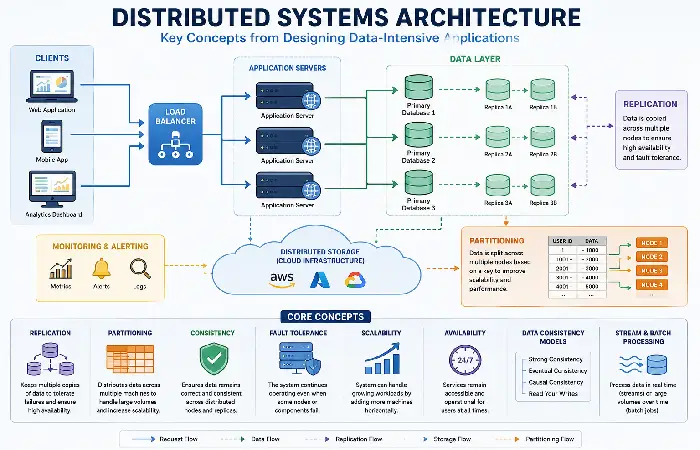
Rather than teaching syntax, the book explains architectural thinking.
Major topics include:
Data Models
Understanding relational, document, graph, and key-value databases.
Storage Engines
How databases organise and retrieve information efficiently.
Replication
Keeping multiple copies of data synchronised across servers.
Partitioning
Distributing data across multiple machines for scalability.
Transactions
Maintaining data consistency during concurrent operations.
Distributed Systems
Handling failures, communication delays, and network partitions.
Stream Processing
Processing continuous flows of real-time data.
Batch Processing
Working efficiently with very large datasets.
What Makes the Book Popular?
Several factors contribute to its strong reputation within the software engineering community.
- Vendor-neutral explanations
- Clear architectural concepts
- Practical examples
- Real-world system design discussions
- Long-term relevance
- Balanced treatment of different technologies
Rather than recommending one technology over another, the author explains the strengths and limitations of each approach.
Comparison: This Book vs Framework Tutorials
| Feature | Designing Data-Intensive Applications | Framework Tutorials |
| Focus | System Design Principles | Specific Technology |
| Lifespan | Long-term | Changes Frequently |
| Suitable for Interviews | Excellent | Moderate |
| Practical Coding | Limited | Extensive |
| Architectural Knowledge | Excellent | Limited |
| Beginner Friendly | Intermediate | Often Beginner |
Framework tutorials help you build applications, while this book helps you understand why large systems are designed the way they are.
What Readers Should Expect
Before starting the book, it’s important to have realistic expectations.
Strengths
- Comprehensive coverage of distributed systems
- Clear explanations of complex concepts
- Technology-independent approach
- Strong focus on architectural thinking
Limitations
- Not designed for complete beginners
- Contains relatively little hands-on coding
- Requires concentration due to technical depth
- Better suited to readers with programming experience
Understanding these expectations helps readers determine whether the book matches their learning goals.
How to Access the Book Legally (Workflow)
If you’re searching for the Designing Data-Intensive Applications PDF, following a legitimate access route ensures you receive the latest edition, complete content, and any publisher updates.
Step 1 – Decide Your Preferred Format
Choose whether you prefer:
- Printed book
- Ebook
- Library copy
- Institutional access
Step 2 – Check Authorised Retailers
Visit reputable booksellers or ebook platforms to see which formats are available in your country.
Step 3 – Explore Library Access
Many universities, technical institutes, and public libraries provide digital or physical access through licensed subscriptions.
Step 4 – Compare Pricing
Digital editions are often less expensive than printed copies. Compare prices across authorised retailers before purchasing.
Step 5 – Begin Reading
Start with the early chapters on data models and storage engines before progressing to more advanced topics such as distributed systems and stream processing.
Key Concepts Explained
One reason the book is highly regarded is its ability to explain complex engineering ideas in a practical way.
Reliability
Reliable systems continue operating correctly even when hardware, software, or network failures occur.
Scalability
Applications should handle increasing numbers of users and larger datasets without major redesigns.
Maintainability
Good software architecture makes future improvements easier while reducing operational complexity.
Replication
Copies of data are stored across multiple servers to improve availability and fault tolerance.
Partitioning
Large datasets are divided across different machines to distribute workload efficiently.
Consistency
The book explains different consistency models and how they affect distributed applications.
Real-World Applications
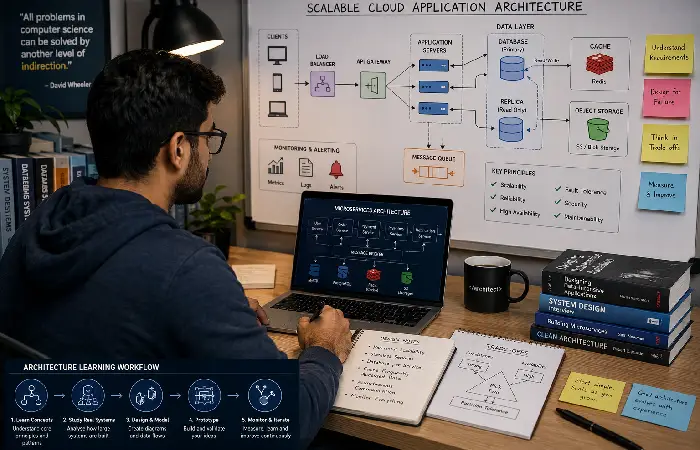
The principles discussed in the book apply to many modern systems, including:
| Industry | Example Use Case |
| Social Media | News feeds and messaging systems |
| Banking | Secure transaction processing |
| E-commerce | Inventory and order management |
| Video Streaming | Content delivery and recommendations |
| Cloud Computing | Distributed storage services |
| Healthcare | Large-scale patient data management |
| Logistics | Real-time shipment tracking |
Although technologies vary, the architectural concepts remain widely applicable.
Pros and Cons
| Pros | Cons |
| Vendor-neutral explanations | Technically demanding for beginners |
| Covers distributed systems in depth | Limited step-by-step coding examples |
| Remains relevant despite technology changes | Requires time to study thoroughly |
| Excellent for system design interviews | Some concepts may need supplementary learning |
| Practical architectural insights | Not intended as a beginner programming book |
Alternatives to Designing Data-Intensive Applications
If you want to broaden your understanding of software architecture, these books are also well regarded.
| Book | Best For |
| System Design Interview | Technical interview preparation |
| Clean Architecture | Software architecture principles |
| Building Microservices | Microservices design |
| Release It! | Production-ready software |
| Site Reliability Engineering | Large-scale operations |
| Designing Distributed Systems | Cloud-native architecture |
Each focuses on different aspects of software engineering, making them useful companions rather than direct replacements.
Who Should Buy This Book?
This book is a good choice for:
- Backend developers
- Software architects
- Cloud engineers
- DevOps professionals
- Database engineers
- Computer science students
- Senior developers preparing for system design interviews
- Engineers working with distributed applications
Who May Want Another Resource First?
You may prefer a beginner-friendly resource if you:
- Have little or no programming experience.
- Are learning your first programming language.
- Need hands-on coding tutorials rather than architectural concepts.
- Want quick practical examples instead of theoretical discussions.
Building a programming foundation before reading this book can make the material easier to understand.
Buying Tips
Before purchasing, consider the following:
- Check whether you prefer a physical or digital edition.
- Ensure the retailer is authorised.
- Compare prices across different sellers.
- Look for institutional or library access if available.
- Verify that you’re purchasing the latest edition.
These steps help ensure you receive a legitimate and complete copy.
Frequently Asked Questions
What is Designing Data-Intensive Applications PDF?
It commonly refers to the digital edition of Martin Kleppmann’s book on distributed systems, databases, and scalable software architecture.
Is there an official PDF version?
The book is available in authorised digital formats through licensed retailers. Availability of PDF or other ebook formats depends on the publisher and retailer.
Is it suitable for beginners?
Readers with basic programming knowledge can benefit from it, but complete beginners may find it challenging.
Which topics does the book cover?
It explains databases, replication, partitioning, transactions, distributed systems, stream processing, batch processing, consistency, scalability, and reliability.
Is the book still relevant in 2026?
Yes. The architectural principles remain applicable even as technologies evolve.
How long does it take to finish?
This varies by experience level. Many readers complete it over several weeks while taking notes and revisiting technical concepts.
Does the book include programming exercises?
The focus is on architectural principles rather than coding exercises.
Can students benefit from reading it?
Yes. Computer science and software engineering students often use it to build a deeper understanding of distributed systems.
Is it useful for technical interviews?
Yes. Many software engineers recommend it for learning concepts commonly discussed in system design interviews.
Should I download unofficial PDFs?
Using authorised editions helps ensure accuracy, supports the author and publisher, and reduces the risk of incomplete or altered copies.
Conclusion
Searching for Designing Data-Intensive Applications PDF usually reflects a desire to learn modern software architecture rather than simply obtain a file. Martin Kleppmann’s book continues to be recognised as one of the most comprehensive resources on distributed systems, data storage, and scalable application design.
While unofficial copies may appear online, choosing authorised editions or library access is the safest and most reliable approach. By studying the concepts presented in the book and applying them through practical projects, readers can build a stronger understanding of the challenges involved in designing reliable, maintainable, and scalable data-intensive applications.

