

Searching “what does Giardia poop look like” in India will most commonly show a presentation of diarrhoea, loose or liquid, that can be greasy and with an unpleasant smell, and which sometimes floats in the toilet. Unfortunately, as a presentation of poop alone cannot differentiate an infection of giardiasis from other bowel diseases and conditions.
Giardiasis infection is transmitted by the smallest organism Giardia duodenalis an intestinal protozoon. This can get into the mouth and thus in the gut, by food, water, objects or faeces which have become infected.
For readers based in India, the possibility of a Giardia infection should arise particularly when the use of unfiltered or unclean drinking water, of contaminated food, or even the existence of zones with poor hygienic standards, occurred.
Important:
Giardia symptoms Giardia symptoms There’s no way to confirm you have it by examining the stool However, a doctor may suggest a stool test for symptoms suggesting giardiasis.
Table of Contents
What Does Giardia Poop Look Like?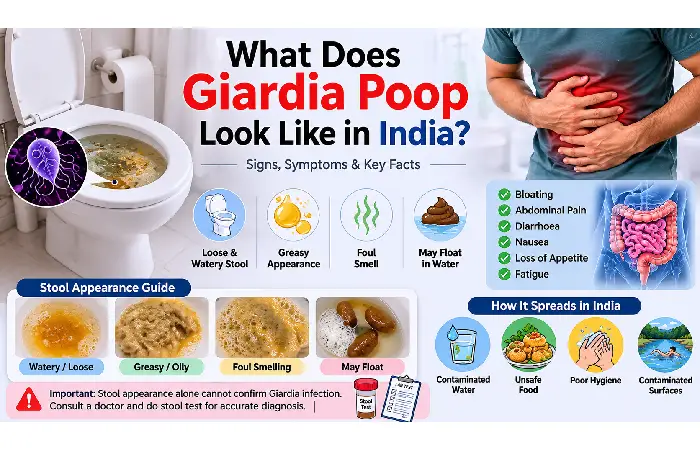
Giardia-associated stool does not have one exact appearance. According to the CDC, a characteristic symptom can be smelly, greasy stool that may float. Diarrhoea is also the most common symptom.
An Indian healthcare source, Apollo Hospitals, similarly describes giardiasis diarrhoea as potentially starting as watery stool and becoming greasy and foul-smelling.
Common characteristics of Giardia stool
| Stool characteristic | What it may look or feel like |
| Consistency | Loose, soft or watery |
| Appearance | May look greasy or oily |
| Smell | Often unusually foul-smelling |
| Floating | May float because of excess fat |
| Frequency | Diarrhoea may occur several times a day |
| Duration | Can continue for weeks in some people |
| Colour | There is no single colour that confirms Giardia |
The salient point is that greasy, fow-smelling and floating stools are suggestive but not diagnostic.
Why Can Giardia Cause Greasy Poop?
Giardia takes up residence in the small intestine, and it disrupts digestion. Giardia can block the absorption of fat; excess fat in the stool can cause floating or greasy stools.
If you have giardiasis, you might have experienced an alteration from what is normal for you; an unusual consistency is a symptom of giardiasis, as this can indicate the malabsorption.
However, don’t assume greasy stools mean you’re a victim.
Giardia Poop vs Normal Diarrhoea
It can be difficult to distinguish Giardia from other causes of diarrhoea simply by appearance.
| Feature | Giardia may cause | Ordinary diarrhoea may cause |
| Watery stool | Yes | Yes |
| Greasy stool | Commonly described | Sometimes |
| Floating stool | Possible | Possible |
| Strong unpleasant smell | Possible | Possible |
| Bloating and gas | Common | Possible |
| Stomach cramps | Possible | Possible |
| Symptoms lasting weeks | Possible | Less typical for some short-term infections |
| Diagnosis by appearance alone | No | No |
Giardia can cause symptoms for 2–6 weeks, although some people have no symptoms at all.
Other Symptoms of Giardiasis
Changes in stool are only one possible sign. Other symptoms can include:
- Diarrhoea
- Excessive gas
- Bloating
- Stomach cramps or abdominal pain
- Nausea
- Tiredness
- Dehydration
- Weight loss in some cases
The CDC reports that symptoms commonly begin 1–2 weeks after infection, although the timing can vary.
Apollo Hospitals also lists appetite and weight loss, abdominal cramps, vomiting, nausea, gas and constipation among possible symptoms. For more related articles visit our website
Can Giardia cause symptoms without diarrhoea?
Yes. Some people infected with Giardia have no symptoms at all. Others can experience digestive symptoms that do not always follow the classic diarrhoea pattern.
How Do People Get Giardia in India?
Giardia spreads when a person swallows the parasite, usually through contaminated material.
Potential sources include:
- Contaminated drinking water
- Contaminated food
- Poor hand hygiene
- Surfaces contaminated with infected stool
- Contact with infected people
- Swallowing contaminated recreational water
Giardia can be present in the faeces of infected people and animals, and the parasite can survive outside the body for extended periods.
For people in India, practical precautions include drinking safe, treated water, maintaining hand hygiene and being careful with food and water when sanitation conditions are uncertain.
How Is Giardia Diagnosed?
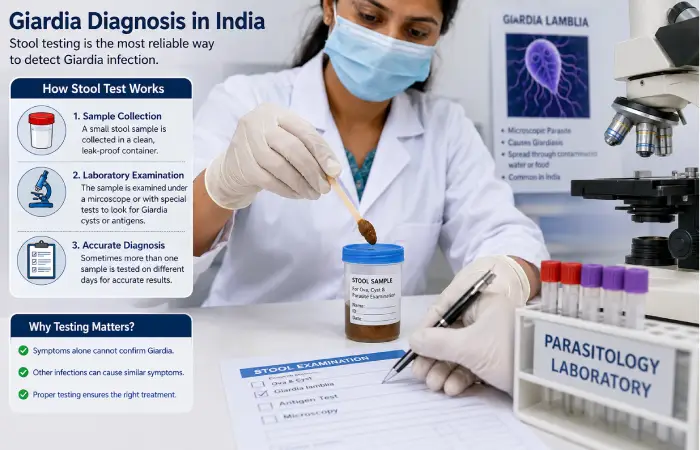
You cannot reliably confirm Giardia by examining your stool at home.
A healthcare professional may request one or more stool samples for laboratory testing. Testing can look for Giardia organisms or other evidence of infection.
Sometimes more than one sample is requested because Giardia may not be present in every bowel movement.
Common diagnostic approach
| Step | What happens |
| 1. Symptoms reviewed | Doctor assesses diarrhoea, bloating, stool changes and exposure history |
| 2. Stool sample | A sample is collected for laboratory examination |
| 3. Laboratory testing | The sample is checked for Giardia |
| 4. Additional samples | More samples may be requested if necessary |
| 5. Treatment decision | Treatment is based on the diagnosis and individual circumstances |
If you have persistent diarrhoea or symptoms that concern you, speaking with a doctor is safer than trying to identify Giardia from stool appearance alone.
When Should You See a Doctor?
Consider medical evaluation if diarrhoea is persistent, keeps returning, or is accompanied by significant abdominal symptoms, dehydration or unexplained weight loss.
You should also seek medical advice if:
- Diarrhoea continues for several days or keeps recurring
- You have signs of dehydration
- You are losing weight without trying
- A child has persistent diarrhoea
- Symptoms started after potentially unsafe water or food exposure
- You have ongoing greasy or unusually foul-smelling stools
- You have a weakened immune system
Persistent diarrhoea can have many causes, so proper testing is important.
Can Giardia Poop Be Normal?
Yes. Not everyone with Giardia develops the classic greasy or floating stool.
Some infected people have no symptoms, while others develop diarrhoea, gas, cramps or other digestive problems.
Therefore, normal-looking stool does not completely rule out Giardia, and unusual-looking stool does not prove that you have it.
How Can You Reduce the Risk of Giardia?
Good hygiene and safe water practices can reduce exposure.
| Prevention step | Why it matters |
| Drink safely treated water | Reduces exposure to contaminated water |
| Wash hands with soap | Helps prevent faecal-oral transmission |
| Wash food properly | Reduces contamination risk |
| Avoid swallowing recreational water | Water can contain Giardia |
| Keep bathroom areas clean | Helps reduce contamination |
| Handle nappies carefully | Faecal contamination can spread Giardia |
| Stay home when experiencing diarrhoea | Helps reduce transmission to others |
Giardia spreads easily through contaminated water, food, hands, objects and surfaces.
Frequently Asked Questions About
- What does Giardia poop look like?
Giardia poop may be loose or watery, greasy, unusually foul-smelling and sometimes floating. However, stool appearance varies and cannot confirm an infection.
- Does Giardia poop always float?
No. Floating stool can occur with Giardia, but not every person with giardiasis will have floating stool.
- Does Giardia cause greasy stool?
It can. Giardia may interfere with fat absorption, which can contribute to greasy or oily-looking stool.
- What colour is Giardia poop?
There is no single stool colour that identifies Giardia. Consistency, greasiness, odour and associated symptoms may be more relevant, but laboratory testing is needed for diagnosis.
- Does Giardia cause foul-smelling poop?
Yes. Strongly unpleasant-smelling, greasy stool is a recognised symptom of Giardia infection.
- How long does Giardia diarrhoea last?
Symptoms commonly last around 2–6 weeks, although some infections can persist longer.
- Can you have Giardia without diarrhoea?
Yes. Some people have Giardia infection without symptoms.
- Can a stool test detect Giardia?
Yes. Healthcare professionals can use stool samples to check for Giardia. Sometimes several samples collected on different days are needed because Giardia may not be present in every sample.
- Is Giardia common from contaminated water?
Contaminated water is one recognised way Giardia spreads. Drinking untreated water or swallowing contaminated recreational water can expose a person to the parasite.
- Should I take medicine if my stool looks like Giardia poop?
No. Do not self-diagnose or start anti-parasitic medicine solely because your stool looks greasy or unusual. Several conditions can cause similar symptoms. A doctor can determine whether testing or treatment is appropriate.
Final Takeaway
What to Expect ForGiardia- infected stool?
“If you’ve asked what do Giardia poop looks like, usually there would be diarrhea or loose, watery stools that would potentially be greasy, bad-smelling, possibly floats”. He noted these qualities alone were not sufficient for a diagnosis of giardiasis.
“If individuals are struggling with diarrhea that won’t go away or strange, greasy stools, particularly after contact with contaminated foods or water (especially while traveling in parts of India) ….
They should talk to their healthcare providers and they’ll probably order stool studies,” she advised.

